Today, my Fannie Farmer’s Cookbook trading card arrived by post.
I’m nuts for cookbook-related ephemera like advertising, book reviews, brochures, etc.
The card, published in 1960, states that “over three million copies of Fannie Farmer’s Cookbook have been sold since its first appearance in 1896.”
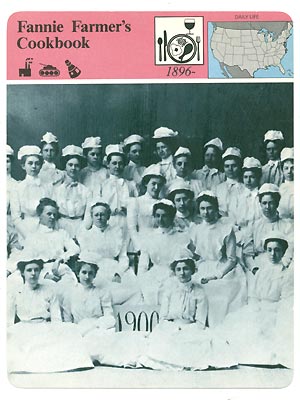
Fannie Farmer’s Cookbook
A Revolution in Home Cooking (1896-?)
Over three million copies of Fannie Farmer’s Cookbook have been sold since its first appearance in 1896. In its way, this cookbook revolutionized home cooking. While it avoided difficult, exotic recipes, it boasted a unique feature: it taught cooking as a precise science. Recipes were printed with accurate, standardized measurements, so that each dish would emerge from the kitchen the same every time.
The author, Fannie Merritt Farmer, was born in Boston, Massachusetts, on March 23, 1857. A semi-invalid, she developed an interest in cooking and was sent by her parents to the Boston Cooking School for advanced training. After graduating in 1889, she became an assistant to the director and two years later she was named director. Meanwhile she had begun collecting and compiling recipes and cooking techniques from the school’s files and her own experience. These were published for the first time in 1896 under the title The Boston Cooking School Cook Book.
The book became an instant success. In the 19 years that passed before Fannie Farmer’s death in 1915, 21 editions were published. The first edition introduced the subject of “cookery, … the art of preparing food for the nourishment of the body,†and noted that
“progress in civilization has been accommpanied by progress in cookery.†That same cookbook, which has been reprinted, revised, and updated continuously since its original publication, still emphasizes accurate measurement.
In 1902 Fannie Farmer formed her own school, called Miss Farmer’s School of Cookery. The Boston Cooking School had been established to train teachers of cookery, but Farmer wanted to teach housewives how to cook. She also taught invalid cookery and gave lectures to nurses on the subject. She even taught her course on invalid cookery one year at the venerable Harvard Medical School. Farmer wrote many other cookbooks, including Food and Cookery for the Sick and Convalescent (1904), What to Have for Dinner (1905), and Catering for Special Occasions with Menus and Recipes (1911). Although shy and retiring, she was much in demand as a speaker. Even after being confined to a wheelchair by a stroke a few years before her death, she continued her work. She always hoped that her cookbooks, especially the still popular Boston Cooking School Cook Book, would “awaken an interest through its condensed scientific knowledge which will lead to deeper thought and broader study of what to eat.â€
Illustration: Fannie Farmer and her cooking class, 1900
© 1960, Panarizon Publishing Corp. USA
Photo Mass. HistoricaI Society
Printed in Italy 030125006
the text above is printed on on the reverse of the trading card
 Steinberg and Scharffenberger co-wrote a cookbook/memoir, The Essence Of Chocolate. The book, published in 2006, contains 100+ recipes by the two and by noteworthy pastry chefs like Flo Braker, Jim Dodge, Thomas Keller, . . . And, Steinberg and Scharffenberg trace growth of their careers and their passion for chocolate as well.
 ust. He was 83.
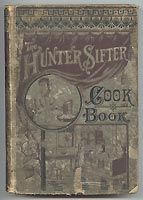 Although I’m off today, I worked on some auction listings; including one for the Hunter Sifter Cook Book.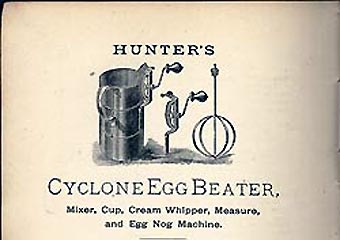
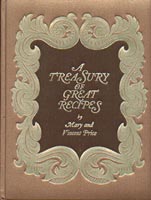 It’s ghoulicious! Vincent Price can help you make all your meals more macbre.