Archive for the ‘20th Century’ Category

Capital City Cook Book (1906)

Friday, February 27th, 2009

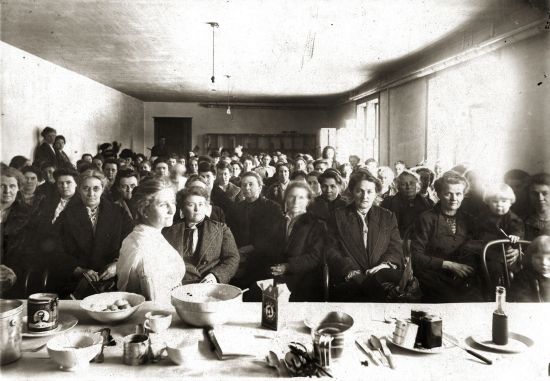
Read Mary Bergin’s article Classes taught immigrants how to cook American-style meals from Wisconsin’s State Journal. In addressing “the cooking school movement,” she refers to Capital City Cook Book (1906) published by the Woman’s Guild of Grace Church of Madison, Wisc. 1906, in the article and in particular to Mrs. G.W. Oakley’s recipe for breaded eggs.

Judy Bart Kancigor’s Melting Pot Memories

Tuesday, October 14th, 2008

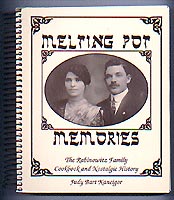
Kancigor, Judy Bart. (1999). Melting pot memories: the Rabinowitz Family cookbook and nostalgic history. Fullerton, CA: Jan Bart Publications. 259 pp. Index. Printed in sepia on cream colored paper and with matching sepia photographs.

Melting Pot Memories by Judy Bart Kancigor 2001 I compared a fourth printing (2001) of Melting Pot Memories (MPM) with Kancigor’s latest book Cooking Jewish (CJ). The copyright page of CJ lists the years 1997, 2003 and 2007. I speculated that CJ was a mainstream publisher’s (Workman) version of the privately published MPM.
Kancigor says, “. . . every time I reprinted MPM, which was a self-published book, I made changes and improvements. There were 8 printings! Now, the difference between my self-published book and my new cookbook, COOKING JEWISH, published by Workman is huge!! Cooking Jewish has 704 pages, over 500 family photos, tons more stories and is totally revamped. There are many new recipes, but even where I used a recipe that was in MPM, it is totally rewritten, because my new publisher really taught me how to write a recipe! And in the thorough, more professional test kitchen many adjustments were made.”

More Marcella Hazan

Monday, October 13th, 2008

Today Matt Davis, of the Portland Mercury, published a refreshing post, On Not Interviewing America’s Most Famous Italian Cookbook Author.

Interview with Judy Kancigor

Sunday, October 12th, 2008

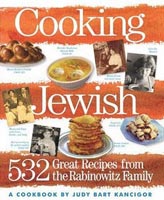
front cover of of Judy Bart Kancigor's cookbook, Cooking Jewish Read Linda Morel’s interview, with the author of Cooking Jewish (532 Great Recipes from the Rabinowitz Family).
Kancigor is an Orange County-based food writer. She also speaks about Jewish cooking and family life at synagogues, women’s organizations, and cooking schools. She lives with her husband, Barry, in Fullerton, California.
The Kancigors privately published Judy’s first book, Melting Pot Memories.

Joy of Cooking, page update

Sunday, October 12th, 2008

Today, I revised and expanded the publishing history of the Joy of Cooking page on the store’s website.

home page of cookbookjjdotcom

Settlement Cook Book article

Saturday, October 11th, 2008

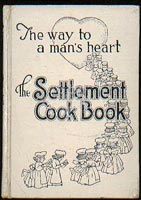
Read the article in Milwaukee Magazine: “Settlement Cookbook still dishes up warm memories by managing editor,” Bobby Tanzile.

Settlement Cook Book 1931

“Joy Of Cooking” research study

Monday, October 6th, 2008

75th_anniversary_Joy_of_Cooking
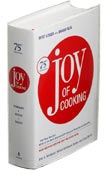
Dr. Brian Wansink, of the Cornell Food and Brand Lab, is the author of a new research study on the Joy of Cooking.
The study involved comparing 18 recipes that have survived the various editions of Joy. 1936, 1946, 1951, 1963, 1975, 1997 and 2006 were the editions used in the study.

Researchers documented the serving size and caloric in each version of the 18 recipes. They found that 17 of the recipes underwent changes that mirrored America’s obestiy epidemic.

Dr. Wasink comments, “What we think is a normal serving size has increased dramatically over the last 70 years … as has what we demand in terms of fat and sugar in a recipe.”

“According to the study, in 1936, the average number of calories in each recipe was 261. The most recent recipes average 384 calories, an increase of 60 percent. If you were to compare just the recipe for sugar cookies, you would find an 142 percent increase in the number of calories from the 1936 recipe to today’s recipe.

Paul Newman

Saturday, September 27th, 2008

Hollywood veteran leading man, auto racing enthusiast, food conglomerate philanthropist Paul Newman died yesterday at his Westport, Ct. home. He had returned home from the hospital following chemotherapy in August. He was 83.

Newman and writer, A.E. Hotchner, founded Newman’s Own in 1982. Their first product was all-natural Newman’s Own Salad Dressing. Other all-natural products like spaghetti sauce, popcorn, lemonade, salsa, steak sauce followed.

title page of Shameless Exploitation

Early on, the boys established the Newman’s Own policy Newman's Own Cookbook 1985 that all proceeds from the sale of Newman’s Own products, after taxes, be donated to charity. The Hole In The Wall Gang summer camps for for seriously ill children are the among the most well-known recipients.

Newman and Hotchner authored several recipe books:

  • Newman’s Own Cookbook (1985) [Newman's Own's first cookbook by this name] Hole In The Wall Gang Cookbook
  • Hole In The Wall Gang Cookbook: Kid-friendly Recipes For Families To Make Together (1998)
  • Newman’s Own Cookbook (1998) [published under the same title as the 1985 cookbook, but with different text and recipes]
  • Shameless Exploitation In Pursuit Of The Common Good (2003) [A business biography/memoir than contains Newman's Own's Good Housekeeping Magazine Winning Recipes, company chronology, etc.]

Newman's Own Salad Dressing Cartoon from Shameless Exploitation

Fannie Farmer trading card

Saturday, September 20th, 2008

Today, my Fannie Farmer’s Cookbook trading card arrived by post.
I’m nuts for cookbook-related ephemera like advertising, book reviews, brochures, etc.
The card, published in 1960, states that “over three million copies of Fannie Farmer’s Cookbook have been sold since its first appearance in 1896.”

fannie farmer trading card

Fannie Farmer’s Cookbook
A Revolution in Home Cooking (1896-?)

Over three million copies of Fannie Farmer’s Cookbook have been sold since its first appearance in 1896. In its way, this cookbook revolutionized home cooking. While it avoided difficult, exotic recipes, it boasted a unique feature: it taught cooking as a precise science. Recipes were printed with accurate, standardized measurements, so that each dish would emerge from the kitchen the same every time.
The author, Fannie Merritt Farmer, was born in Boston, Massachusetts, on March 23, 1857. A semi-invalid, she developed an interest in cooking and was sent by her parents to the Boston Cooking School for advanced training. After graduating in 1889, she became an assistant to the director and two years later she was named director. Meanwhile she had begun collecting and compiling recipes and cooking techniques from the school’s files and her own experience. These were published for the first time in 1896 under the title The Boston Cooking School Cook Book.
The book became an instant success. In the 19 years that passed before Fannie Farmer’s death in 1915, 21 editions were published. The first edition introduced the subject of “cookery, … the art of preparing food for the nourishment of the body,” and noted that
“progress in civilization has been accommpanied by progress in cookery.” That same cookbook, which has been reprinted, revised, and updated continuously since its original publication, still emphasizes accurate measurement.
In 1902 Fannie Farmer formed her own school, called Miss Farmer’s School of Cookery. The Boston Cooking School had been established to train teachers of cookery, but Farmer wanted to teach housewives how to cook. She also taught invalid cookery and gave lectures to nurses on the subject. She even taught her course on invalid cookery one year at the venerable Harvard Medical School. Farmer wrote many other cookbooks, including Food and Cookery for the Sick and Convalescent (1904), What to Have for Dinner (1905), and Catering for Special Occasions with Menus and Recipes (1911). Although shy and retiring, she was much in demand as a speaker. Even after being confined to a wheelchair by a stroke a few years before her death, she continued her work. She always hoped that her cookbooks, especially the still popular Boston Cooking School Cook Book, would “awaken an interest through its condensed scientific knowledge which will lead to deeper thought and broader study of what to eat.”

Illustration: Fannie Farmer and her cooking class, 1900

© 1960, Panarizon Publishing Corp. USA
Photo Mass. HistoricaI Society
Printed in Italy 030125006

the text above is printed on on the reverse of the trading card

Letters – Marcella (Hazan) Remembers

Wednesday, September 17th, 2008

Today, The New York Times (food section) published two letters in response to last week’s article, Marcella Remembers.